Creating a More Connected Student Experience with Q-Flow
September 1, 2026
September 1, 2026
Across eight campuses, a Florida college supports a high volume of students seeking assistance with admissions, academic advising, registration, financial aid, and other essential student services. Managing these interactions consistently across multiple locations requires more than simply moving students through a line. It requires connected systems, clear communication, visibility into demand, and an experience that works for both students and staff.
The college partnered with ACF Technologies to create a more unified approach to student service delivery with Q-Flow. First introduced across five campuses in 2013, the solution was later expanded to all eight locations, connecting appointment scheduling, check-in, queue management, student communications, feedback, and operational reporting within a more consistent service environment.

Before implementing Q-Flow, the college's eight campuses relied on different systems to manage student services. The lack of consistency created confusion for students and staff while making it difficult to maintain a unified approach to service delivery across locations.
Communication was another challenge. The college wanted a more effective way to reach students on their mobile devices but was relying on an outdated process that sent email messages through a mobile carrier. The method was cumbersome and did not provide the level of reliability the college needed for timely student communications.
At the same time, improving the student experience had become an important priority. The college needed a better way to collect feedback, understand student sentiment, evaluate service performance, and analyze information across its campuses. Without a centralized solution, gaining meaningful visibility into these areas was difficult.
The goal was to create a more connected service environment that could simplify student interactions while giving staff and administrators greater control and insight into daily operations.
The college worked with ACF Technologies to integrate Q-Flow into its student service operations.
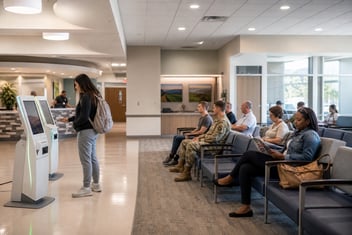
A key part of the implementation was connecting Q-Flow with the college's existing student records system. When a student checks in at a kiosk using a student ID, Q-Flow automatically passes the information to the student records system. This allows existing students to be identified and directed to the appropriate next step in their service journey without requiring staff to manually repeat the process.
From this foundation, the college expanded the role of Q-Flow across the student experience, introducing online appointment booking, mobile access, student feedback, SMS communication, reporting, and capacity controls.
The expansion of Q-Flow across all eight campuses created a more connected approach to student service delivery. Students now receive more reliable and immediate communications through SMS, giving the college a more dependable way to share appointment reminders, service updates, surveys, and other important information.
The college also gained greater visibility into student sentiment and the overall service experience across its campuses. Feedback and reporting tools provide a clearer view of how students are interacting with services, while streamlined check-in and appointment processes have made it easier for students to access support and arrange appointments.
Together, these improvements have created a more consistent student service environment in which appointment scheduling, arrival, communication, feedback, reporting, and capacity management work as connected parts of the overall experience.


For a college operating across eight campuses, consistency is critical. Students should be able to access services without having to navigate entirely different processes depending on the location they visit, while staff need the visibility and tools to manage demand effectively.
By integrating Q-Flow with existing student systems and expanding access through mobile scheduling, virtual check-in, SMS messaging, feedback, and centralized reporting, the college established a stronger foundation for managing student services across its campus network.
What began as an implementation across five campuses ultimately expanded to all eight, giving the college a more unified way to support students from the moment they schedule or arrive through the completion of their service interaction.
Is your organization looking to improve wait times and customer experience with intelligent queue management?